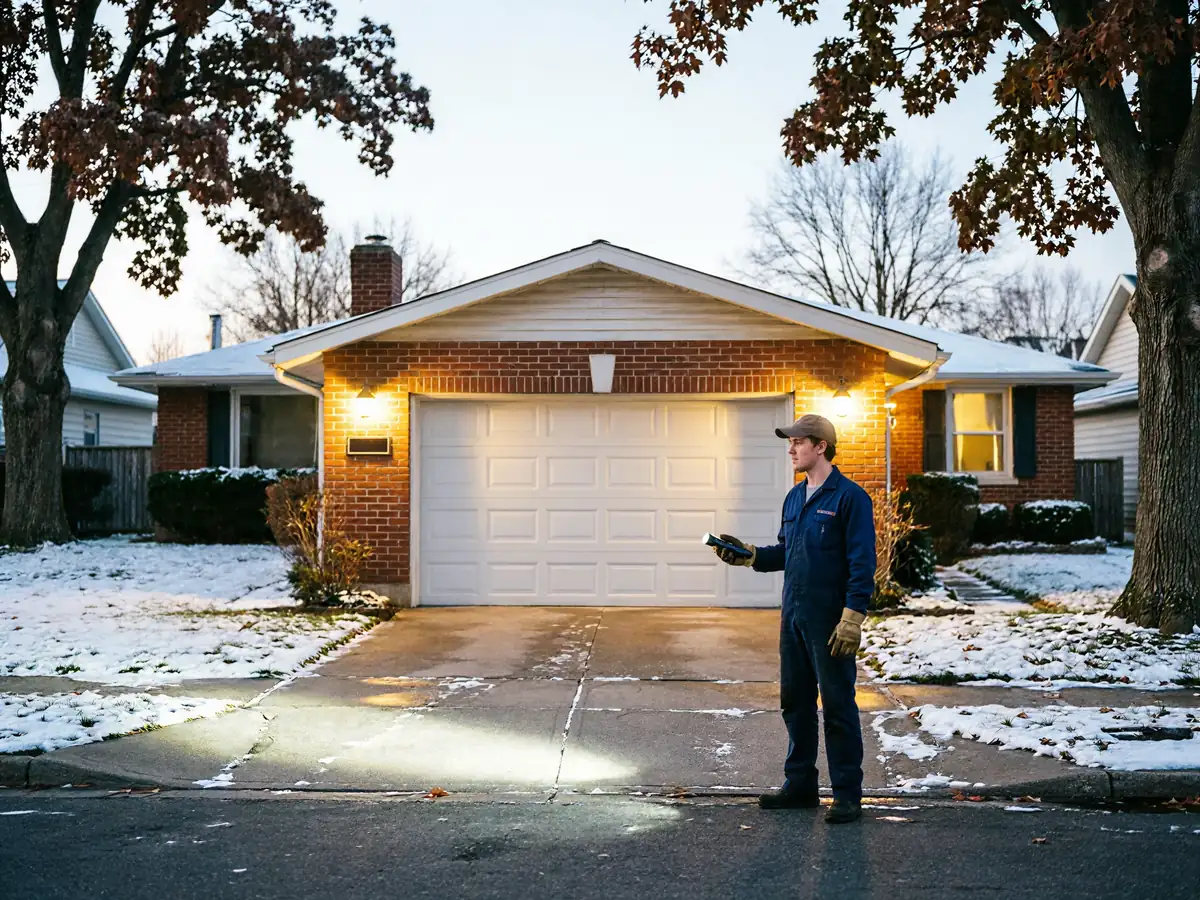
Des Plaines homes built mostly in the 1960s and 70s often carry original torsion springs that snap in cold snaps. Here's why, and what to do when it happens.
And that matters more to a torsion spring than most owners think. Steel contracts as the temperature drops, and a spring that's been winding and unwinding for decades doesn't contract evenly - microscopic fatigue cracks that have been building for years finally have somewhere to go. That's not a scare story, it's just what cold metal does.
02
The housing stock here makes it worse
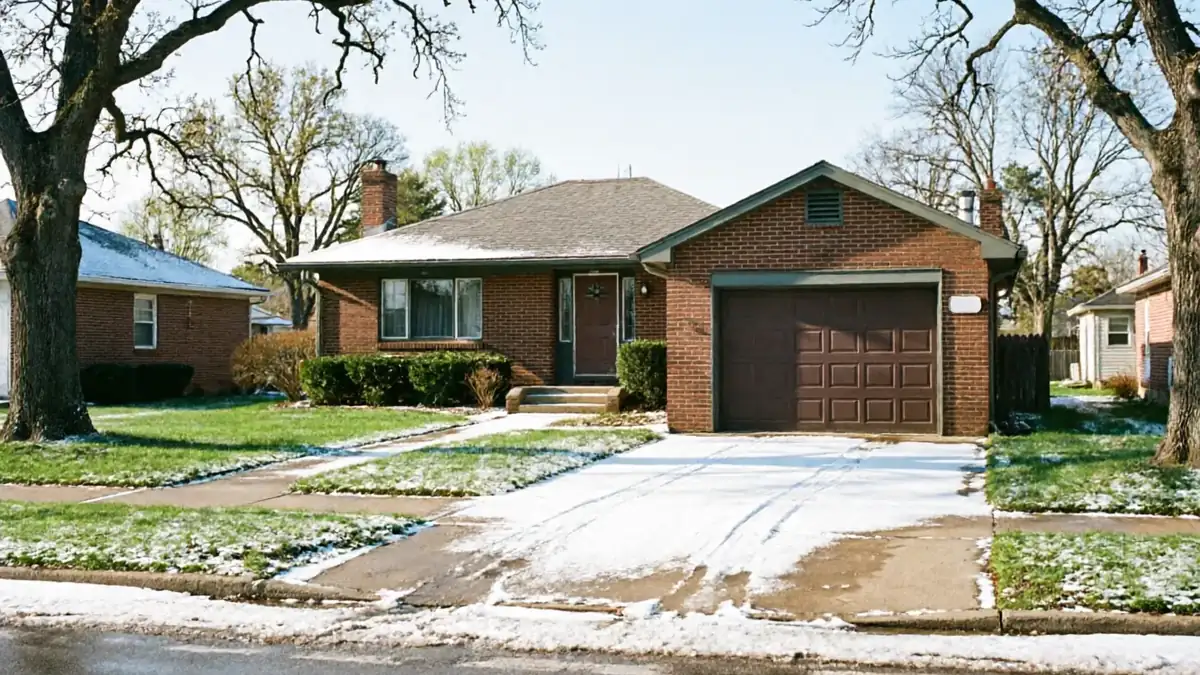
Most of Des Plaines went up between 1938 and 1996, with the median build year landing around 1972, and the bulk of it clusters in that 1960s-70s wave across the area's 87 named pockets. A house built in 1968 that's never had its spring swapped is running hardware that's now past 55 years old. Torsion springs don't last forever under normal cycling, and a spring installed during that build boom has seen roughly five decades of winters, each one flexing steel that's slowly losing its temper.
55 years
03
So when a cold front rolls through and a spring lets go, it's rarely random
It's the combination of a specific age of house and a specific swing in temperature meeting in the same week. That's why this isn't a generic maintenance tip - it's tied to what's actually in the ground here.
When Waiting Is Fine
Not every noisy or stiff door needs a same-day call. If the door still opens and closes at a normal speed, closes flush, and the opener isn't straining or reversing on its own, you likely have some surface rust or a little lost lubrication rather than a spring on the edge of failure. A light squeak on a cold morning that goes away once the door's been run a few times is usually just stiff grease, not a structural problem.
Here's the honest limitation: we can't tell you over the phone whether a spring is fine or about to go. Visual fatigue on a torsion spring is hard to see even in person until a coil has visibly gapped or separated. So "wait and see" only makes sense if the door is behaving normally - smooth travel, no sagging, no loud bang when it's idle. If any of that changes, waiting stops being the safe option, because a spring under tension that fails doesn't fail quietly, and it can take a cable or a section of track with it.
If your house falls in that 1960s-70s band and the spring has never been replaced, treat any change in sound or motion as a reason to look now rather than in spring.
The Problem
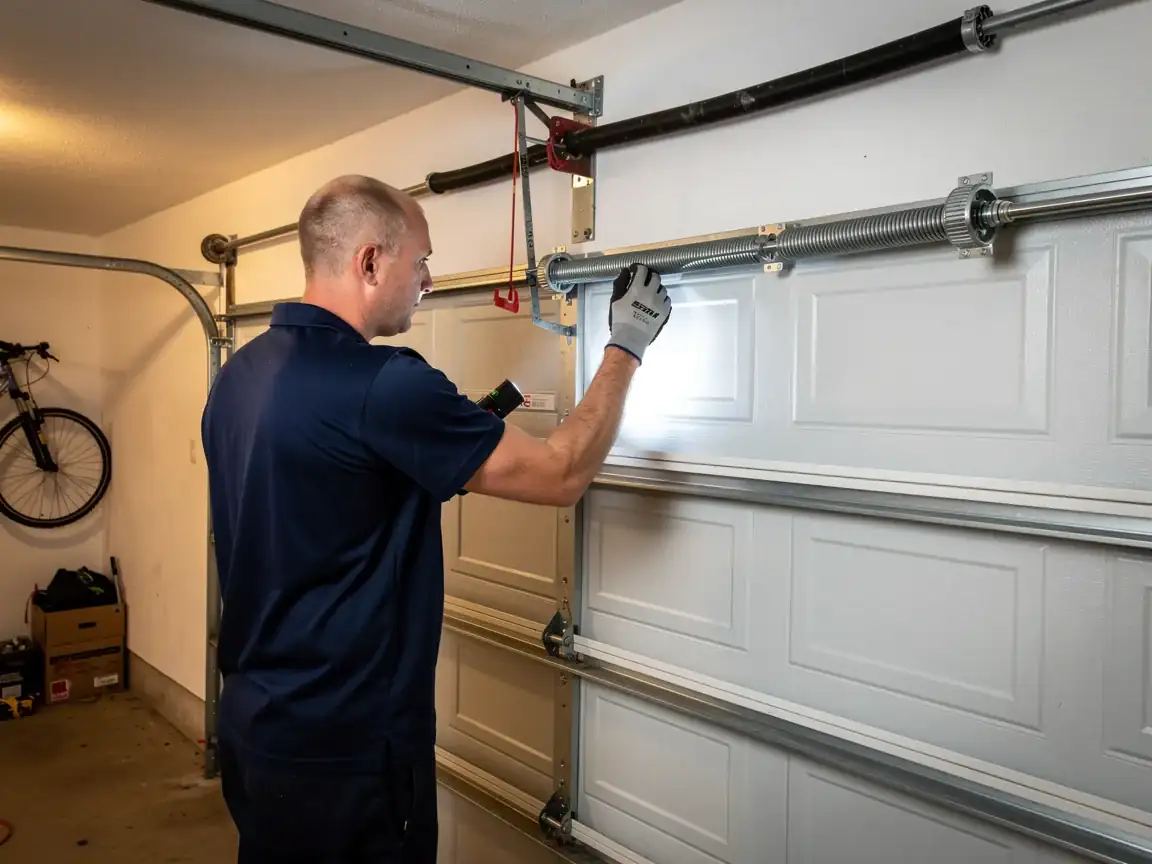
A torsion spring holds enormous stored energy all the time, not just when the door is moving. Cold weather doesn't create that energy, but it changes how the steel handles it. As the coil contracts, any existing fatigue crack - the kind that accumulates after tens of thousands of open-close cycles - has less room to flex around, and it's more likely to run the rest of the way through the coil. That's the mechanical reason spring failures cluster during cold snaps rather than being spread evenly across the year.
In Des Plaines, this lines up with a housing stock that skews older. A median build year of 1972 means a large share of original hardware is well past the point where manufacturers expect a spring to still be in service. Across the wider service area, with 218,505 owner-occupied houses built in that same general window, a hard cold week doesn't produce one isolated failure - it produces a run of them, house after house, because the springs are all roughly the same age.
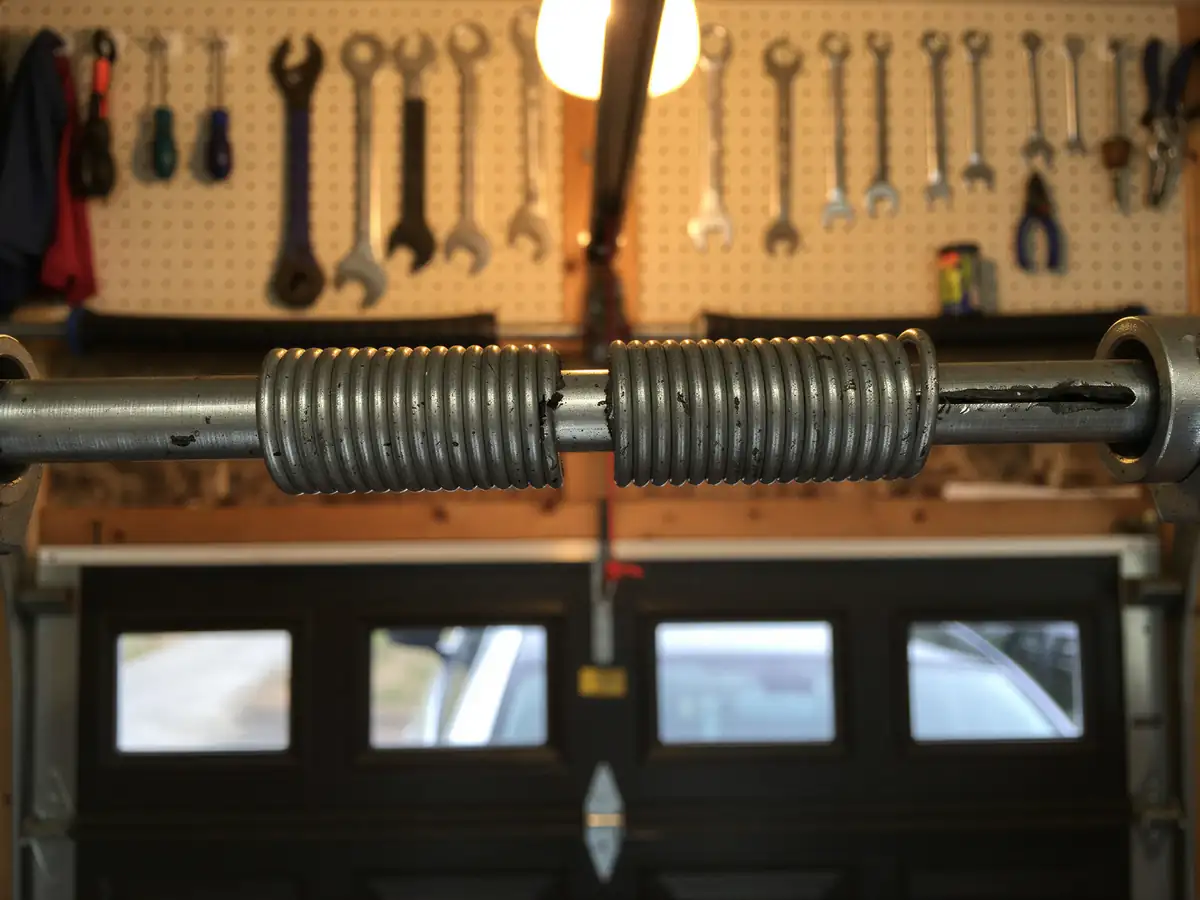
The failure itself is loud - a bang from the garage, a door that suddenly won't lift, or one side hanging lower than the other because only one spring let go on a double door.
What to Check
01
Before calling anyone, a few things are safe to look at from outside the door's travel path
Never reach toward the spring itself. First, look at the two coils above the door. A gap where the coil has visibly separated, or a spring that looks twisted and uneven compared to its mate, means it's done or close to it.
02
Second, try the door only if it's currently down and stays down safely
If one side of a double door looks lower than the other, or the door is cocked at an angle in the opening, stop - that's a sign one spring has already gone and the other is carrying the full load.
03
Third, check for a loud bang you heard earlier in the day or overnight
Especially after a sharp temperature drop. That sound, paired with a door that now won't lift with the opener, is close to a confirmed spring failure.
04
Last, if your house is part of that 1960s-70s wave common across Des Plaines and you don't know the spring's history
Assume it's original until someone's told you otherwise. Given the median household income here of $103,911, most owners in this situation choose a straight replacement over trying to nurse an old coil through another winter.
How it works
From “it’s stuck” to “it’s fixed”
01
Tell us what’s wrong
Describe the symptom - won’t open, loud bang, opener runs but the door won’t move.
02
On-site diagnosis
A technician tests the door under power and by hand and finds what actually failed.
03
Clear, up-front plan
You get the fix that’s needed and what drives the cost - before any work starts.
04
Repaired & tested
The repair is done, the door is set true and tested, and the work area left clean.
Next step
Not sure which repair your door needs in Des Plaines, IL? Describe what it’s doing - every job starts with a diagnosis.
Straight answers about garage door repair in Des Plaines. Still unsure? Ask us directly.
Why do garage door springs break more in winter in Des Plaines?
Cold steel is less forgiving of the fatigue cracks that build up over years of normal use. Des Plaines sits in a cold-moderate climate band, and with so much of the housing stock dating to the 1960s and 70s, a lot of original springs are already decades past their expected service life when a cold snap hits.
Can I replace a torsion spring myself?
We'd rather you didn't. A torsion spring under tension can cause serious injury if it releases while you're working near it. It's one of the few repairs where the risk isn't worth the money saved, especially on older hardware where you can't always tell how much tension is actually stored.
How old is too old for a garage door spring?
There's no fixed number, but if your house was built during the 1960s or 70s wave common across Des Plaines and the spring has never been swapped, it's well past the point manufacturers design for. Age alone, especially in a house from that window, is a reason to have it looked at before winter.